
Start Your Product Development Project With Confidence
Successful product development begins long before engineering starts.
The Product Development Readiness Review helps organizations evaluate product requirements, technical risks, project scope, and development priorities so they can launch projects with greater confidence and fewer surprises.
Why Many Projects Struggle Before They Even Begin
Many development challenges are created long before the first CAD model is built or the first circuit board is designed.
Projects often begin with:
Unclear product requirements

Unclear product requirements
Unrealistic budgets
Poorly defined scope
Undefined customer needs
Aggressive schedules
Unidentified technical risks
Changing stakeholder expectations
Are You Ready to Start Product Development?
You may benefit from a Product Development Readiness Review if:
You have an idea but not detailed product requirements

You’re unsure if your concept is technically feasible.
You’re evaluating development partners.
You’re unsure how much engineering will be required.
You’re seeking accurate development proposals.
Multiple stakeholders have different expectations.
You’re concerned about cost or schedule uncertainty.
You need a clear product development roadmap.
What We Evaluate
Product Vision
Is the product objective clearly defined?
User Needs
Who is the product for? What problem does it solve?

Functional Requirements
What must the product do?

Technical Complexity
What engineering challenges are anticipated?

Manufacturing Considerations
Are manufacturing constraints already influencing design decisions?

Business Objectives
Budget, timeline, market expectations, success metrics.

Risks & Unknowns
Identify assumptions before they become expensive.

Two Possible Outcomes. One Clear Next Step.
The review determines which path is right for your project.
Evaluate Requirements, Risks, Technical Complexity & Unknowns
PATH 1
Development Ready
You have the information needed to support a development proposal.
————— DELIVERABLES
Product Requirements Specification
Initial Scope of Work
Development Phase Recommendations
Preliminary Budget Range
Preliminary Schedule
What You Can Do Next
Use these deliverables to request proposals from:
Internal Engineering Team

SPEED

Another Development Partner
PATH 2

More Discovery Needed
You have the information needed to support a development proposal.
————— DELIVERABLES
Technical Risk Assessment
Key Unknowns
Feasibilty Objectives
Recommended Phase 0 Scope
Preliminary Schedule
What You Can Do Next
Complete the Phase 0 project with:
Internal Engineering Team
SPEED
Another Development Partner

CHOOSE THE DEVELOPMENT PARTNER THAT’S RIGHT FOR YOU
With clear requirements and scope, you can make a confident, informed decision.
Why Phase 0 Feasibility Projects Often Save Time and Money
When significant technical unknowns exist, a focused Phase 0 effort reduces risk and prevents costly rework later.
A Phase 0 project helps:
Validate technical assumptions
Evaluate architecture options
Reduce technical risk
Define product requirements
Establish realistic budgets
Develop an achievable schedule
Align stakeholders
Improve proposal accuracy

Path Comparison
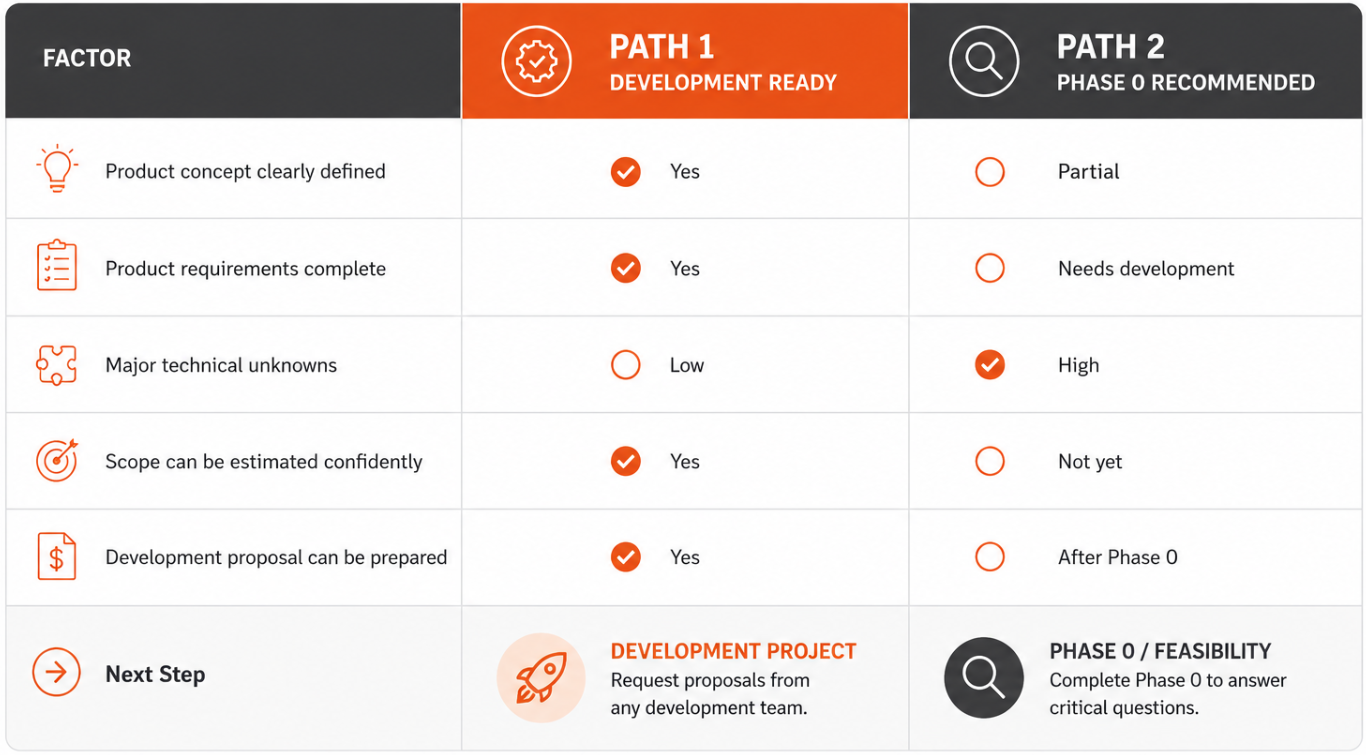

The goal isn’t to convince you to choose SPEED.
The goal is to ensure that, regardless of who develops your product, the project begins with clear requirements, realistic expectations, and a well-defined scope.

Frequently Asked Questions
-
The Product Development Readiness Review™ is a structured planning engagement that helps determine whether your product is ready to begin engineering. We evaluate product requirements, technical complexity, project scope, business objectives, and key unknowns to identify the most appropriate path forward. The outcome is a clear set of recommendations that reduces uncertainty before significant development resources are committed.
-
A Product Development Readiness Review™ determines whether enough information exists to confidently define a development project.
A Phase 0 / Feasibility Study is recommended only when significant technical unknowns remain that must be resolved before a complete Product Requirements Specification and Scope of Work can be developed.
Think of the Readiness Review as the decision point that determines whether your project is ready for engineering—or whether additional technical investigation is the smarter next step.
-
No.
Many organizations come to us with a product vision, market opportunity, or prototype, but without a complete set of documented requirements.
One of the primary objectives of the Product Development Readiness Review™ is to help define and organize those requirements so your project begins with a clear foundation.
-
That's completely acceptable.
Some clients begin with little more than a product concept and a business objective.
The review helps determine what information already exists, what still needs to be defined, and whether the project is ready for engineering or would benefit from a Phase 0 / Feasibility Study.
-
Depending on the maturity of your project, you will receive one of two outcomes:
Path 1: A Product Requirements Specification and an initial Scope of Work that can be used to request proposals and begin development.
Path 2: A recommendation for a focused Phase 0 / Feasibility project designed to answer critical technical questions before defining the full development effort.
Either outcome provides a clear, actionable next step.
-
Absolutely.
The deliverables created during the Product Development Readiness Review™ belong to you.
You are free to use them with your internal engineering team, SPEED, or another qualified development partner.
Our objective is to help you start your project with clear requirements and a realistic scope—not to create dependency on our services.
-
Preparing a proposal without well-defined requirements often means making assumptions about product functionality, technical complexity, and project scope.
Those assumptions frequently lead to budget overruns, schedule changes, and scope adjustments later in the project.
The Product Development Readiness Review™ replaces assumptions with documented requirements and a structured development plan, resulting in more accurate proposals regardless of who ultimately performs the work.
-
A Phase 0 project is typically recommended when important technical questions remain unanswered.
Examples include:
New or unproven technologies
Multiple architecture options
Undefined product requirements
Complex system integration
Performance uncertainty
Regulatory considerations
Manufacturing concerns
Resolving these questions early reduces technical and financial risk before full-scale development begins.
-
Yes.
Many organizations choose SPEED to execute the development because we already understand the product, requirements, and project objectives.
However, the review is intentionally partner-neutral. You're free to continue with SPEED, your internal engineering team, or another development partner.
Our goal is to help you make an informed decision based on a solid technical foundation. This reflects SPEED's philosophy of providing clarity, structured execution, and lifecycle guidance rather than simply selling engineering services.
-
The timeline depends on the complexity of your product and the amount of information already available.
Projects with well-defined concepts may be completed relatively quickly, while products with greater technical complexity or multiple unknowns may require additional workshops or stakeholder discussions.
The goal is not speed alone—it's ensuring the project begins with the clarity needed for successful execution.
-
Most projects don't exceed budget because engineering is performed poorly.
They exceed budget because the original requirements, assumptions, or scope were incomplete.
As new information is discovered during development, additional work becomes necessary.
Investing time upfront to define product requirements, identify technical risks, and establish a realistic scope significantly improves the accuracy of project estimates and reduces the likelihood of costly changes later.
Great Products Start With Great Planning
Whether your project is ready for full development or requires additional technical investigation, the Product Development Readiness Review provides the information needed to move forward with confidence.
Schedule Your Product Development Readiness Review